
Translational Confidence
Defensible progression, by design.
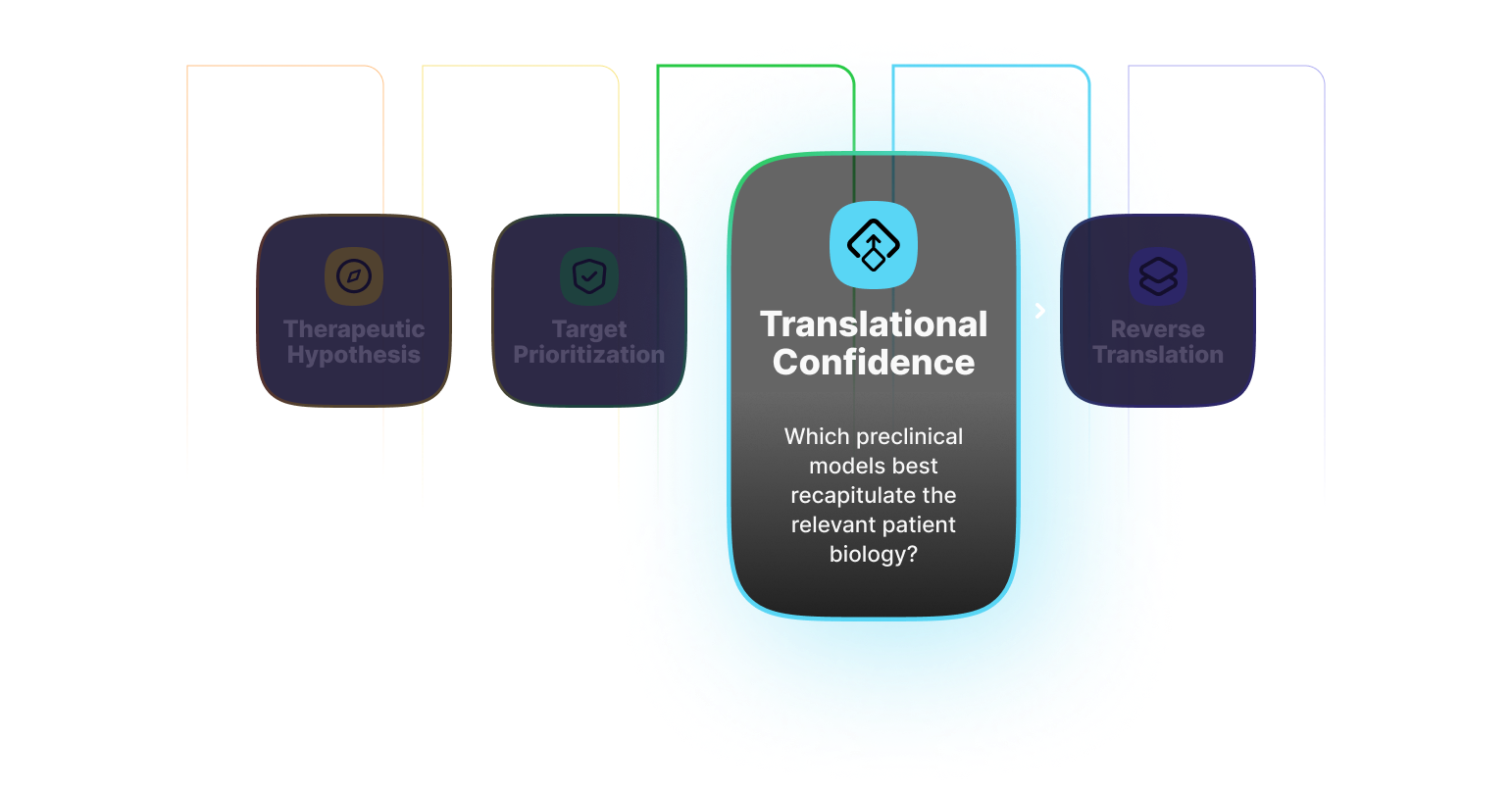
Preclinical signal does not guarantee human relevance.
Before capital, credibility, or clinical trajectory is committed, confidence comes from understanding where your model aligns with patient biology - and where it does not - across the pathways that matter for your therapeutic strategy.
Translational Confidence makes model
fidelity inspectable before progression.
How Translational Confidence Works

1. Clarify the Hypothesis
Define what "alignment" means for this model and this decision.

2. Anchor Signal to Patient Context
Examine how model signal maps to relevant human datasets, and where it diverges.

3. Document the Progression Rationale
Capture assumptions, evidence, and interpretation so the decision remains defensible over time.
A late-stage oncology program showed strong
internal signal.
Translational review exposed misalignment to patient molecular context before IND-enabling spend.
Therapeutic strategy reframed. Capital preserved.
Feeling lost about your program’s next steps?
Bring one active program.
We'll examine it together.
In 30 minutes, we will:
- Review your translational hypothesis
- Examine how model signal maps to patient molecular context
- Identify where alignment holds and where it breaks
- Assess whether the progression rationale is defensible
You leave with a clearer decision and defined next steps.
Book a Translational Confidence ReviewLooking for more detail? View the detailed breakdown
“We were targeting specific arms of a pathway known to be relevant in patients.
Translational Confidence highlighted a clear signature of disease reversal in the preclinical models that helped us progress forward.”