
Learning series
Articles about algorithms, analyses and visualizations in computational biology and bioinformatics.
Why Cell Summary Analysis Is a Game Changer for Translational Teams and How Pluto Makes It Easy
Read more →
Why Bioinformatics Consulting Can’t Keep Up with Modern Discovery
How delays, data silos, and limited visibility slow discovery — and what leading teams are doing instead.
Read more →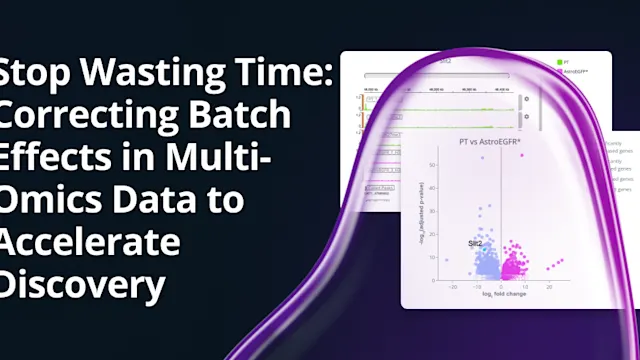
Stop Wasting Time: Correcting Batch Effects in Multi-Omics Data to Accelerate Discovery
Read more →
Unifying Your Science: The Power of an Integrated Multi-Omics Platform
End fragmented data workflows with a secure, collaborative hub for multi-omics research.
Read more →
The Pluto Bio Approach to Batch Effect Correction: Harmonization without Compromise
Read more →
The Hidden Barriers Slowing Translational R&D with Single-Cell Data
Single-cell data is transforming translational research. From oncology to immunology, the ability to resolve cell populations at unprecedented resolution is fueling breakthroughs in target discovery, biomarker identification, and patient stratification.
Read more →
Upgrade Your Translational Bioinformatics Platform
How Pluto Accelerates Collaboration and Insights Across Multi-Omics Data
Read more →
Your RNA-seq Data Is Ready. So Why Are You Still Waiting?
The analysis bottleneck holding teams back
Read more →
Science Tells a Story - Pluto Makes It Actionable
A collaborative platform that helps translational research teams turn multi-omics data into insight, alignment, and impact.
Read more →
Buried in bigWigs? Simplify Your Genomic Data Visualization
bigWig files are powerful for signal visualization — but without context and collaboration, they slow discovery. Pluto connects them to your full workflow.
Read more →
Accelerating cancer research with the Cancer Cell Line Encyclopedia (CCLE)
Accelerate cancer research with the Cancer Cell Line Encyclopedia (CCLE) and Pluto Bio’s no-code platform. Discover biomarkers, test therapies, and unlock insights from extensive cancer cell line data.
Read more →
Unlocking cancer research with The Cancer Genome Atlas (TCGA)
Accelerate cancer research with TCGA data—uncover biomarkers and targets effortlessly using Pluto Bio’s intuitive, no-code bioinformatics platform.
Read more →
Proteomics 101: A primer for translational scientists
Discover how proteomics empowers translational scientists to uncover disease biomarkers, identify novel drug targets, and optimize clinical decisions.
Read more →
GSEA vs ORA: Two key pathway analysis approaches for next-gen sequencing data
Explore the differences between GSEA and ORA for pathway analysis of next-gen sequencing data. Learn how these two key approaches help interpret gene expression results and reveal underlying biological processes.
Read more →
Comparing bioinformatics platforms: Pluto Bio, Partek Flow, Basepair, and Rosalind
Compare top bioinformatics platforms—Pluto Bio, Partek Flow, Basepair, and Rosalind—to find the best fit for your NGS data analysis needs. Assess supported assays, analyses, visualizations, and collaboration features.
Read more →
Navigating the NIH's updated genomic data security best practices: What researchers need to know
Explore NIH's updated genomic data security best practices and learn how researchers can ensure compliance and protect sensitive data using platforms like Pluto Bio.
Read more →
Understanding RNA-seq and scRNA-seq: A guide for biologists
Discover the differences between RNA-seq and scRNA-seq, their applications in target discovery, and how pseudobulking bridges bulk and single-cell analysis. Unlock insights into gene expression for drug development and personalized medicine.
Read more →
Unlocking biological insights with multi-omics approaches
Explore how multi-omics integrates diverse datasets like RNA-seq, ATAC-seq, and ChIP-seq to unlock biological insights, accelerate drug discovery, and drive personalized therapies. Learn more about its impact on cancer research and target identification.
Read more →
Multi-Omics Target Validation: Building an Effective Drug Discovery Pipeline
Discover how Pluto’s multi-omics pipelines accelerate target validation in drug discovery. Learn how integrated platforms streamline the path from omics data to validated therapeutic targets.
Read more →
Alternatives to Rosalind for Bioinformatics and Computational Biology
Discover top alternatives to Rosalind for bioinformatics and computational biology. Explore platforms like Pluto Bio, BaseSpace, GenePattern, and more to find the right solution for your research needs.
Read more →
Annotating cell clusters in single cell RNA-seq datasets
Confidently annotate scRNA-seq clusters with strategies using gene sets, AI tools, and a biology-first approach to uncover cell types and states.
Read more →
Using Multi-Omics Approaches for Effective Target Discovery
Discover how multi-omics revolutionizes drug discovery by integrating genomics, proteomics, and more to reveal complex disease networks, enabling precise target validation and accelerated breakthroughs.
Read more →
RNA-Seq 101 for Biologists
Learn the basics of RNA-seq, including its methodology, applications, experimental design, and data analysis techniques. This 101 overview is perfect for biologists and bioinformaticists investigating transcriptomics for the first time.
Read more →
The importance of considering covariates in RNA-seq and other -omics data analysis
To draw accurate and meaningful conclusions from RNA-seq data, it is essential to consider covariates, which are additional, potentially “hidden” variables that may impact gene expression in your experiment
Read more →
The Origins, Comparisons, and Practical Insights into PRO-seq Technology
Dive into the world of Precision Run-On sequencing (PRO-seq) in this comprehensive blog post. Discover the origins of PRO-seq, how it compares with traditional RNA-seq, and explore a step-by-step guide on conducting a PRO-seq experiment. Uncover how this innovative technology is advancing our understanding of transcriptional dynamics and revolutionizing genomic research.
Read more →
Navigating RNA-Seq Data: A Comprehensive Guide to Normalization Methods
RNA sequencing (RNA-Seq) has revolutionized the way we study gene expression. The data deluge it produces, however, presents a critical question: how can we make valid comparisons between different samples or conditions?
Read more →
Understanding Key File Formats in High-Throughput Research
Learn about key file formats in high-throughput research, including FASTQ, FASTA, BAM/SAM, BAI, SAM, VCF, GFF/GTF, BED, BedGraph, BigWig, and PDB. Discover how each format is used, what information it contains, and its significance in analyzing ChIP-seq and ATAC-seq data. Understanding these formats is crucial for efficiently handling and analyzing high-throughput data, enabling valuable biological insights and discoveries.
Read more →
Accelerating Research Discovery with Bioinformatics Platforms: The Benefits of Implementation
In the field of genomics and bioinformatics, research discovery can be slowed down by the time and resources required to analyze and interpret large datasets. Bioinformatics platforms, which are specialized software or online tools that provide a range of analysis functions, can help to streamline the process and accelerate research discovery.
Read more →
CUT&RUN 101 for Biologists
Curious about CUT&RUN and when you would use it? Learn more in this Pluto blog post about getting started with CUT&RUN.
Read more →
Exploring the Differences Between Computational Biology and Bioinformatics
This blog post explains the differences between computational biology and bioinformatics. Bioinformatics is concerned with the development and application of computational methods for analyzing and interpreting large biological datasets, while computational biology involves mathematical models and computer simulations to study complex biological systems and processes. The post also describes the different tools and platforms used in each field and how modern SaaS platforms are bringing the two fields together. Finally, a top 10 list summarizes the main differences between computational biology and bioinformatics.
Read more →
The Importance of Kaplan-Meier Curves in Computational Biology Research
Kaplan-Meier curves are an essential tool in computational biology research, allowing analysis of survival data and identification of important genes and pathways associated with specific traits or diseases. Learn more about their importance in this blog post. #computationalbiology #KaplanMeier #survivalanalysis
Read more →
What is RSEM?
A mini intro to RSEM, a workhorse in RNA-seq data quantification.
Read more →
Dimensionality Reduction Techniques in Computational Biology: Insights, origins, and Emerging Directions
Unlocking the power of big data in biology with dimensionality reduction techniques. Explore how PCA, t-SNE, and other methods are driving insights in computational biology. #DimensionalityReduction #ComputationalBiology #BigDataInsights
Read more →
Visualizing Genomic Data with IGV Plots: A Powerful Tool for Genomic Research
Discover the power of Integrative Genomics Viewer (IGV) plots - a highly customizable and interactive tool for visualizing and exploring genomic data. Learn how IGV plots can be used in genomic research and the methods for creating data used in these plots. #genomics #bioinformatics.
Read more →
Differential Expression Analysis: Understanding the Techniques and Benefits in Research
Differential expression analysis is a powerful tool used to identify genes or transcripts that are differentially expressed between two or more conditions or sample types. This technique is commonly used in the field of genomics, transcriptomics, and proteomics to study the molecular mechanisms underlying different biological processes, such as disease development, response to treatment, or adaptation to different environments.
Read more →
Understanding Z-scores in RNA-seq Analysis
In this blog post we will explain what Z-scores are how they are calculated and how they can be used in RNA-seq analysis.
Read more →
Revolutionizing Gene Expression: The Power of qPCR
qPCR has transformed molecular biology by providing unparalleled accuracy and sensitivity in the detection and quantification of nucleic acid sequences. Despite its potential drawbacks, such as cost and optimization requirements, qPCR has proven invaluable in research, clinical diagnostics, and food safety testing. Recent advancements in qPCR technology, such as Digital PCR and CRISPR-based qPCR, have further expanded its applications. Learn more about the origins and potential of qPCR in our latest blog post.
Read more →
Unraveling the Power of ChIP-seq: A Guide to Understanding Protein-DNA Interactions
ChIP-seq, or chromatin immunoprecipitation sequencing, is a powerful tool used to study protein-DNA interactions in the genome.
Read more →
Understanding Fraction and Reads in Peaks: A Guide for ChIP-seq and ATAC-seq Analysis
We will explain what these factors are and how they are used to analyze ChIP-seq and ATAC-seq data
Read more →
Exploring the Power of ATAC-seq: A Guide to Understanding Chromatin Accessibility
ATAC-seq, or assay for transposase-accessible chromatin sequencing, is a powerful tool used to study the accessibility of the genome.
Read more →
DESeq2: An Overview of a Popular RNA-Seq Analysis Package
DESeq2 is a popular and widely used package in the field of bioinformatics for the analysis of RNA-Seq data. It provides a more comprehensive view of gene expression compared to traditional microarray technology.
Read more →
Unleashing the Power of Next-Generation Sequencing (NGS) with the Right Software
Next-generation sequencing (NGS) is a powerful tool used to generate high-throughput DNA sequencing data.
Read more →
Cytokine Panels: An In-Depth Guide to Analysis and Significance
Cytokines are small proteins that play a crucial role in regulating the immune system, inflammation, and cell growth.
Read more →
An Introduction to SAMtools: A Powerful Tool for Analyzing Next-Generation Sequencing Data
SAMtools is a software package for interacting with and processing next-generation sequencing data
Read more →
Trimming RNA-seq Data: A Step-by-Step Guide
In this blog post, we will walk through the steps of trimming RNA-seq data using popular software tools such as Trimmomatic and Cutadapt.
Read more →
Understanding the Role of Bioinformatics Engineers
Mastering Key Skills and Coding Languages for Effective Analysis of Biological Data: A Guide to Bioinformatics Engineering
Read more →