
From analysis grid to scientific canvas

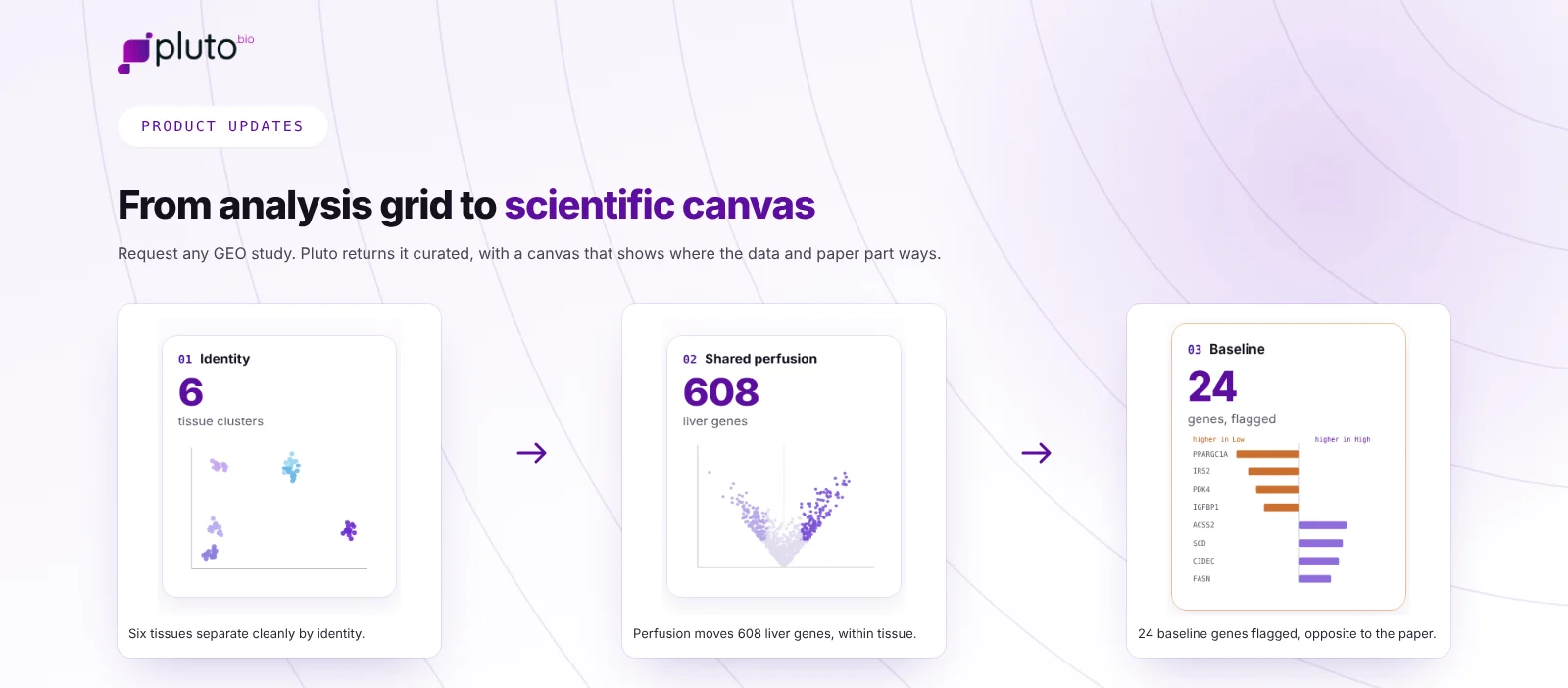
Every GEO study is an argument: this design, these comparisons, this conclusion. Before our new automated pipeline, Pluto handed you the standard plots and left you to rebuild the argument from the paper. Now, each import comes with the argument laid out step by step, with the analyses that test each claim and a written finding under each one.
Until now, a GEO import came with a small set of typical analyses: a PCA, a differential expression comparison and a gene set enrichment plot. A Pluto scientist read the manuscript, picked the headline comparison and tried to reproduce the paper's figures.
For a thyroid eye disease study (GSE329263), that meant one volcano plot of TED versus non-TED, a PCA of all samples and one enrichment curve for E2F targets. The grid of plots showed the data, but what was missing was the reasoning that connects them.
This approach had a few limitations. The same typical analyses were run for every study. Depth depended on who picked up the request and how much time they had to read the paper. And, there was no clear narrative: the plots sat side by side with no reasoning between them, so each user rebuilt the logic from the paper.
Now, the pipeline reads a study the way a careful reviewer would: design first, then the claims, then the evidence for each.
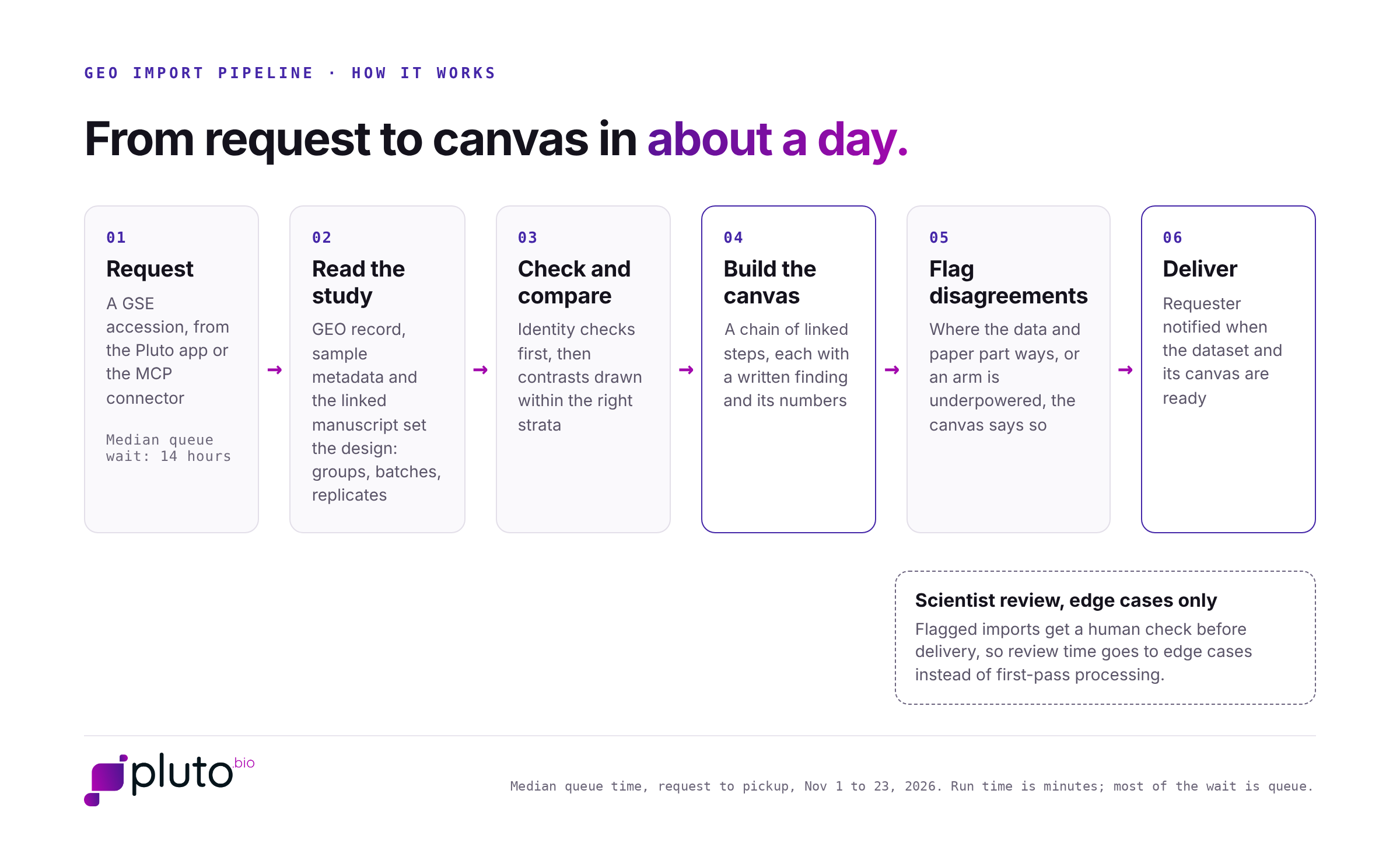
Here's a breakdown of how our updated automated pipeline works:
Once we receive your request, our AI agent reads the study, confirms that the samples are what they claim to be, and starts to build the scientific canvas as an argument. An analysis space is created with a leading hypothesis, and each step of the argument is a panel of plots with a short written finding and its numbers: genes changed, top pathways, and how that compares with the paper. A labeled arrow joins each panel to the next and says why that step follows, such as "compare within each tissue." Importantly, where the deposited data disagree with the paper, or a comparison is underpowered, the canvas says so and records it in the dataset's notebook. Flagged imports get a scientist's check before delivery.
The result opens read-only in the dataset's analysis space. Link the public dataset to your program and rerun any analysis with your own settings or add your own data beside it.
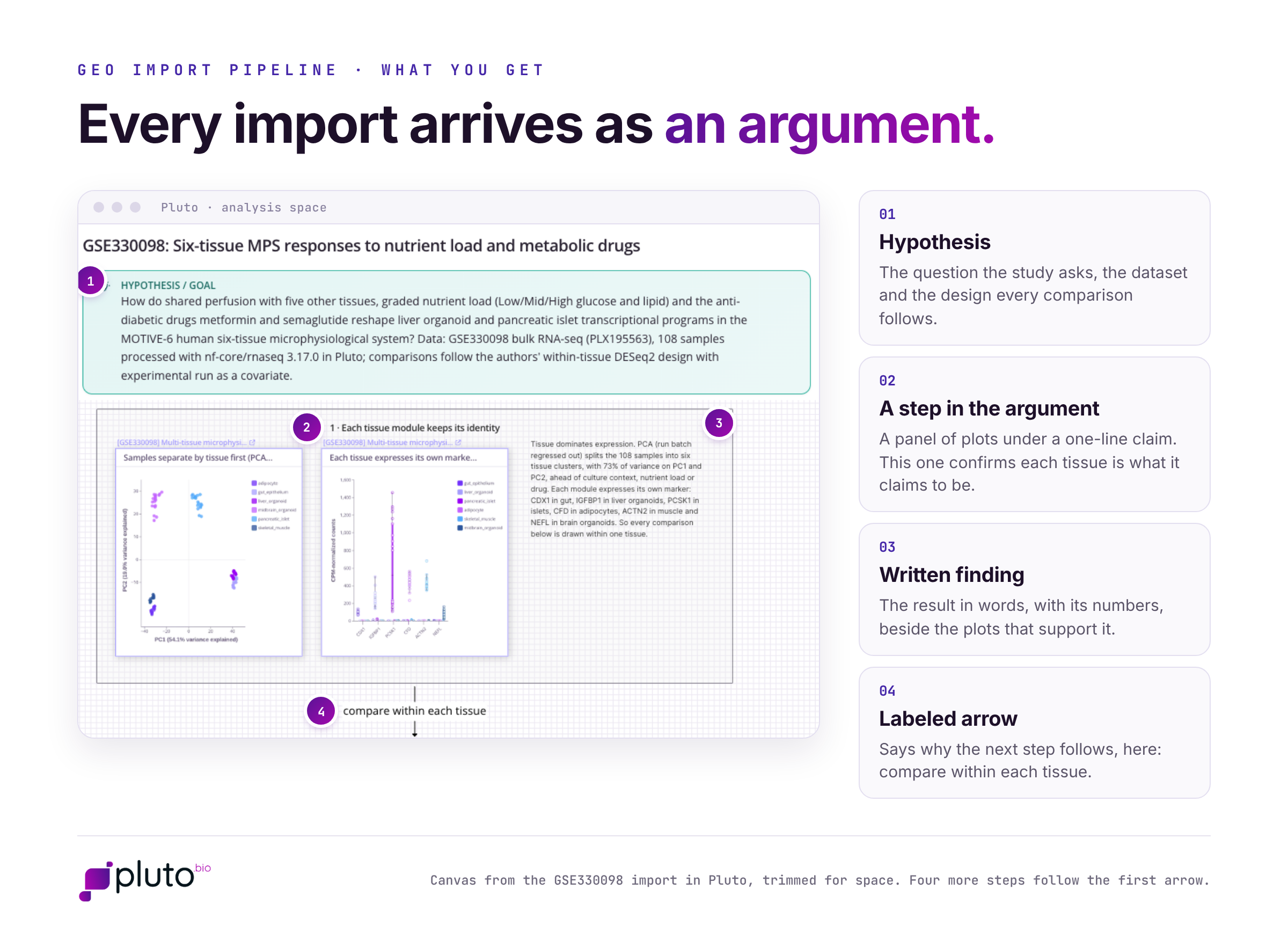
Example use case: a six-tissue microphysiological system
GSE330098 grows six human tissues (gut, liver organoid, pancreatic islet, adipocyte, muscle and midbrain organoid) together under shared perfusion or alone, at low, mid or high nutrient load, with metformin or semaglutide on the high-nutrient arm. It holds 108 bulk RNA-seq samples, processed in Pluto with nf-core/rnaseq. The canvas has five steps. The most useful part is where it disagrees with the paper:
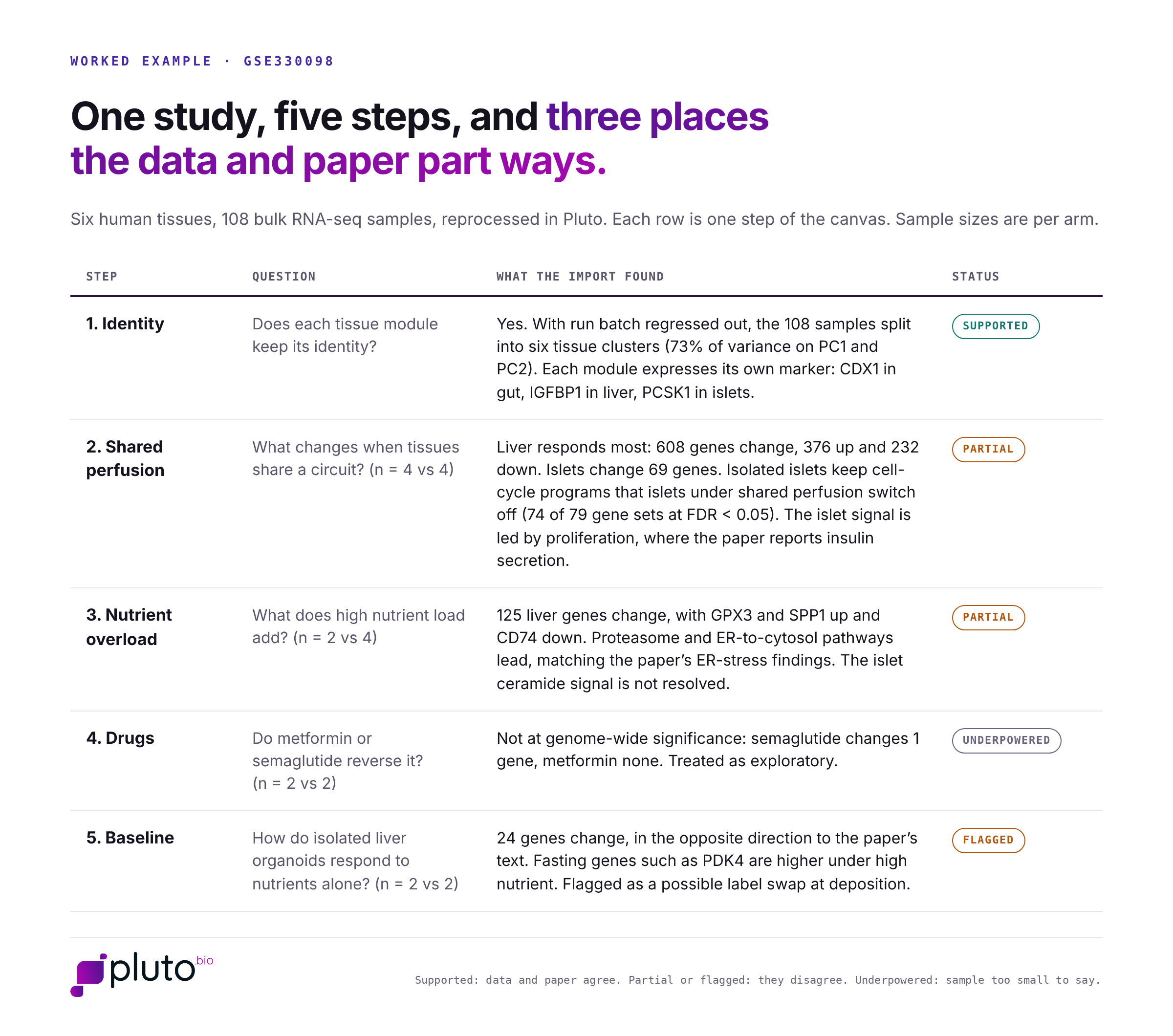
Three of the five steps are where the data and the paper either disagree or cannot settle the question: an islet signal led by proliferation rather than insulin secretion, an islet ceramide signal the deposited subset cannot resolve, and the inverted baseline. A careful reader working from the paper might have caught these. Now they are recorded on the canvas, so the next person starts with them.
Why it matters for translational teams
A canvas changes what the first hour with a public dataset is spent on.
- Know what the data can carry. Underpowered arms and disagreements with the paper are stated up front, so a weak signal does not end up in a program review.
- See the baseline. The depositor's argument sits on the canvas, so it is clear where your hypothesis departs from the original study. That departure is usually where the new insight is.
- Triage in minutes. Rather reconstructing the paper, use your time to see if the study bears on your target or indication by reading five panels.
Existing clients: request a GEO series in the Pluto app or through the Pluto MCP connector, and compare its canvas with the paper your team already knows. Tell us where they part ways.
New to Pluto? Book a demo to see a canvas built from a study in your therapeutic area.