Pluto launches MCP connector, bringing translational science intelligence into the AI assistants R&D teams already use
New connector lets scientists monitor program status, run analyses, and evaluate preclinical models in plain language from ChatGPT, Claude, Microsoft Copilot Studio, and other MCP-compatible assistants
DENVER, CO, November 4, 2026. Pluto Biosciences, the AI-native translational science platform for drug discovery, announced the Pluto MCP connector. Built on the open Model Context Protocol (MCP), the connector gives AI assistants secure, governed access to the programs, datasets, analyses, and results that R&D teams keep in Pluto.
AI assistants are quickly becoming the front door to scientific work, but their answers are only as good as the context behind them. Without access to a team's own program context and data, an assistant can summarize literature but cannot tell a scientist what their own experiments say or what to do next. The Pluto MCP connector closes that gap, so scientists spend less time on the mechanics of analysis and more on the hypotheses that move a program forward. It connects the reasoning of general-purpose AI to the program context, omics data, and analytical rigor that translational decisions depend on.
Program context, available in every conversation
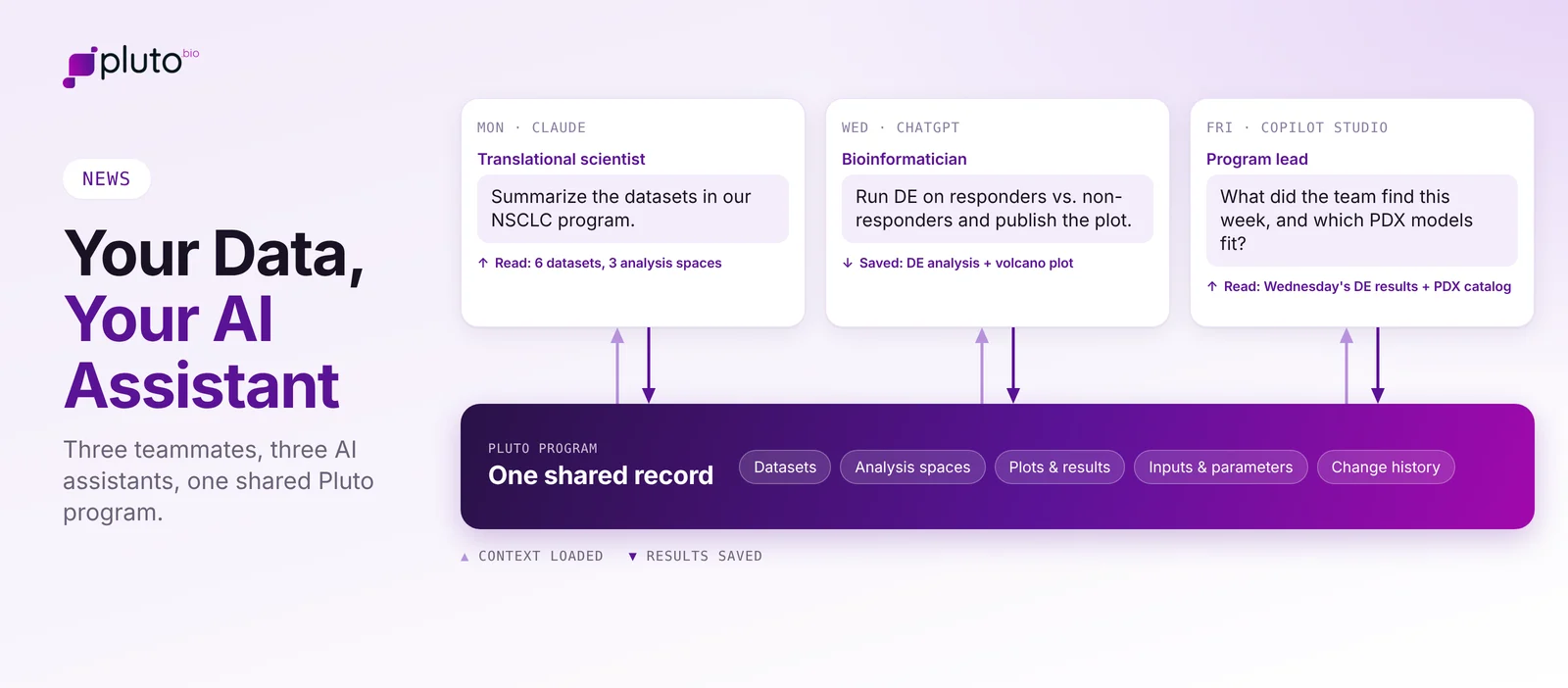
With the connector enabled, scientists can ask their assistant to summarize a program's datasets and analysis spaces, find every NSCLC dataset across their portfolio, or check a study's sample design before planning the next experiment. The assistant can also take action. It can create datasets from processed tables and sample metadata, define comparison groups, run analyses, publish plots to a shared analysis space, and bring results from external tools back into Pluto.
Everything the assistant creates lands in the same program record the rest of the team works from. Exploratory work that once lived in a chat window or a personal notebook becomes part of the program's shared history, traceable to the person and assistant that produced it. Every analysis records its inputs and parameters, so a colleague can rerun it and get the same result.
Better evidence for preclinical model decisions
Choosing the right preclinical model is one of the most consequential and least data-driven decisions in drug discovery. A model that fails to reflect human disease biology can send a program down the wrong path for years. Through the connector, AI assistants can search Pluto's preclinical model catalog and public data commons alongside a program's own data. Teams can then compare candidate models against the biology that matters for their target and indication.
The same conversation can move from question to evidence. Scientists run Pluto validated analysis pipelines across bulk and single-cell omics, including differential expression, pathway and gene set analysis, clustering, and cell type annotation. They can review results and plots, then decide which models, targets, or experiments deserve the next investment. The result is faster, better-documented decisions on model selection, target validation, and program progression. For teams, that means faster hypothesis generation, less manual effort as routine requests come off the bioinformatics team’s plate, and more confidence in each decision. In early use, analyses that once took days to plan and execute were completed in under an hour.
Open by design, governed by default
The Pluto MCP connector is a standard remote MCP server. It works with Claude, Microsoft Copilot Studio, and any assistant that supports custom MCP connectors with sign-in. Pharma teams can bring Pluto into the AI environment their organization has already approved rather than adopting another interface. Because MCP is an open standard, Pluto's capabilities also compose with other connectors and agents in a team's workflow, from literature and clinical trial sources to internal systems.
Security and governance follow the scientist. The connector acts as the signed-in user and respects their existing Pluto permissions. Access uses OAuth, with no shared API keys. Users can limit an assistant to read-only access, approve individual actions, and disconnect at any time. None of the connector's tools delete data, and every change is logged in the program's history.
"Translational decisions are only as good as the context behind them," said Rani Powers, PhD, CEO and founder of Pluto Biosciences. "Scientists are already thinking out loud with AI. The Pluto connector means that thinking context now runs with their program data and on rigorous analysis, and the results flow back into the program instead of disappearing into a chat history. We see Pluto as the translational science layer that makes every AI assistant in R&D smarter about which models, targets, and programs are worth betting on."
Availability
The Pluto MCP connector is available to Pluto customers in their AI of choice: ChatGPT, Claude, Microsoft Copilot Studio and others. Setup takes a few minutes. An organization admin adds the connector once, and each scientist signs in with their own Pluto account. To get started, see these guides:
- Connect your AI assistant to Pluto
- Pluto Bio MCP connector reference
- Connecting the MCP in Microsoft Copilot Studio
Enterprise customers can contact mcp.support@pluto.bio for deployment-specific configuration.
New to Pluto? See how your team could go from question to validated result in one conversation. Book a demo with our Scientific team today.
About Pluto Biosciences
Pluto Biosciences is a translational science platform that helps pharmaceutical and biotech R&D teams decide which preclinical models, targets, and programs are most likely to translate to patients. Pluto brings together multiomics data integration, program context, and AI-native analysis so scientists can move from raw data to defensible decisions in one place. Founded by scientists and headquartered in Denver, Colorado, Pluto works with leading pharmaceutical companies to make translational decisions faster, more rigorous, and better documented. Learn more at pluto.bio.